| James L. Neibaur in... The good: "Air Raid Wardens" The bad: "The Flying Deuces" And the ugly: ? |
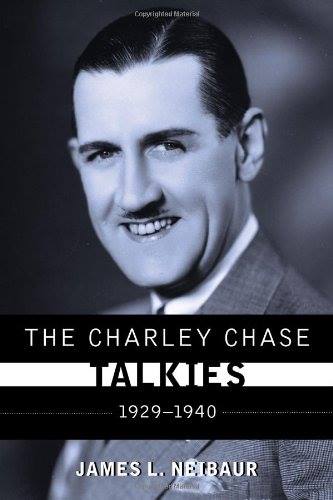
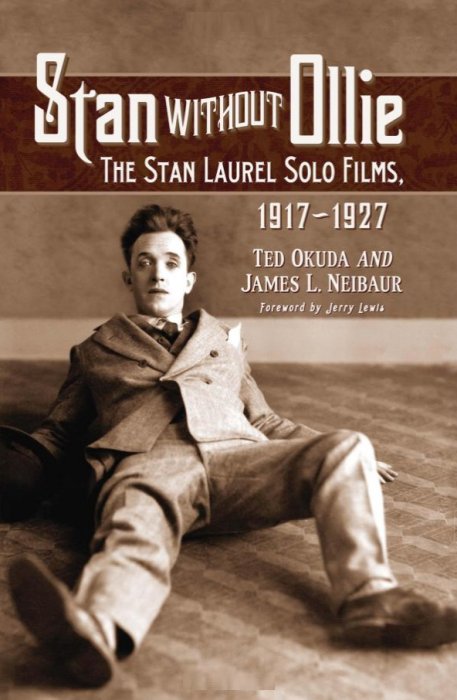
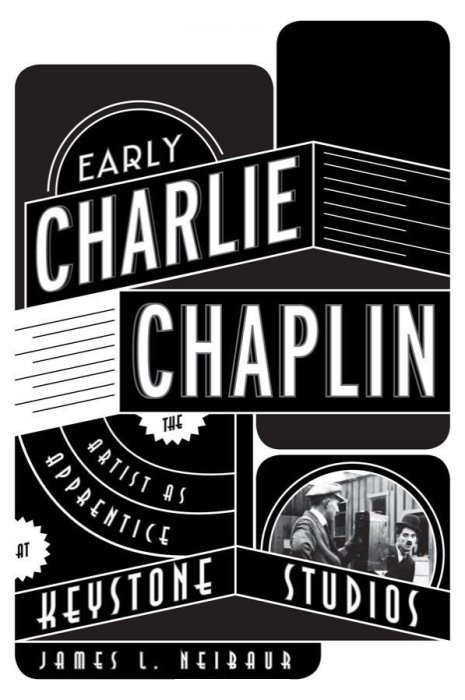
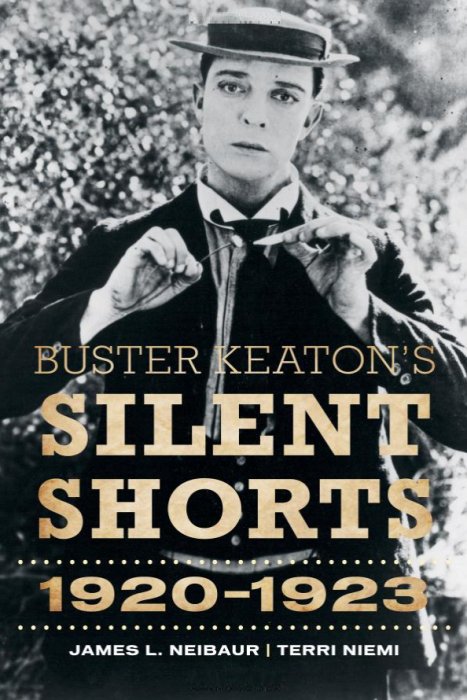
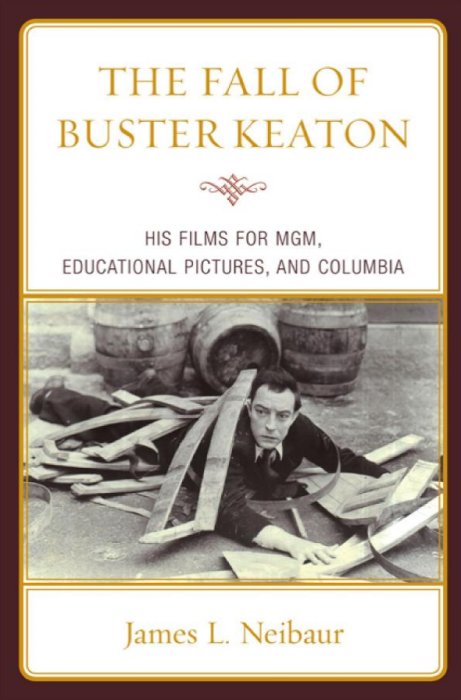
| Jim Neibaur is an American free-lance writer and part-time artist. He currently resides in Racine, Wisconsin, USA. My review on his book, "The Charley Chase Talkies 1929-1940" is available on this website: see here |
|
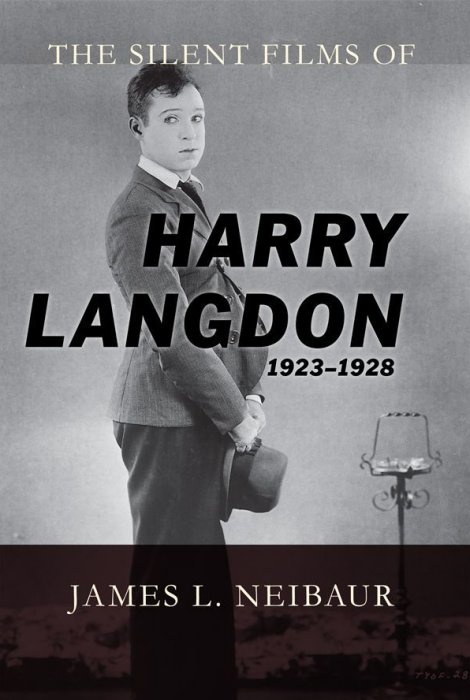
| A selection of Jim's books are available on Amazon.com. Click any book cover above for details. |
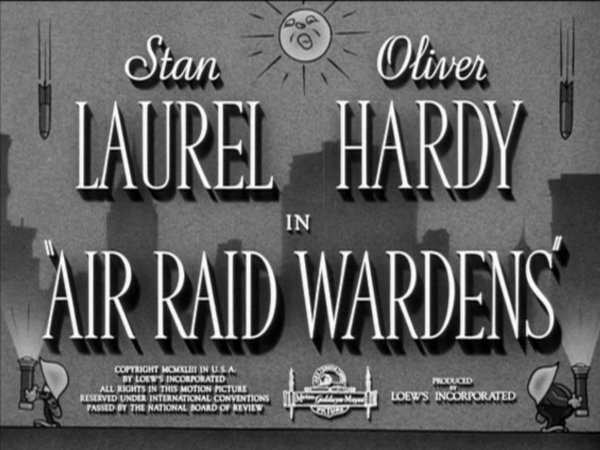
| In May 2014, James Neibaur wrote two *EXCLUSIVE* articles for Another Nice Mess. The first of which bravely, boldy and controversially dissects The Flying Deuces as being "worst" Laurel & Hardy film. Naturally, with so many other more obvious candidates for the unwanted accolade of "worst L&H film" available for discussion, I was intrigued with his choice! Secondly, an analysis on why Air Raid Wardens is worthy of high praise. Two very strange choices in my opinion, but he makes some good points... Disclaimer: The views expressed herein are those of the author and do not necessarily reflect those of this webmaster... but they do make for an interesting read! |
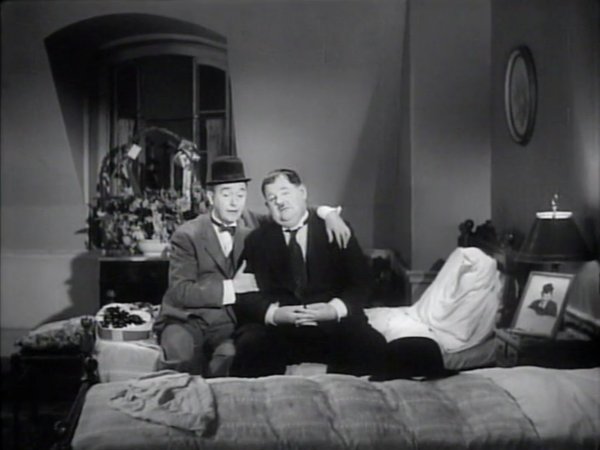
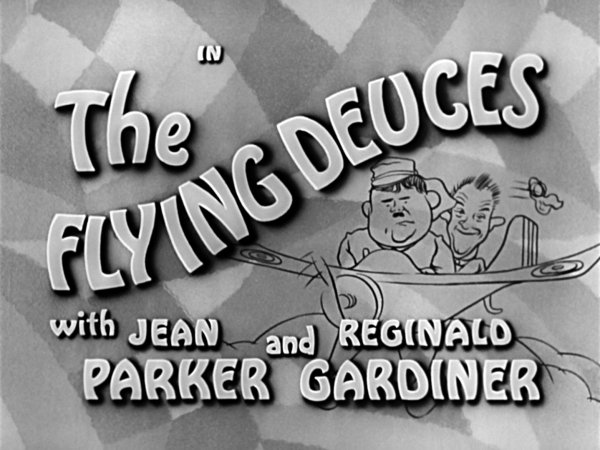
| THE FLYING DEUCES (Edward Sutherland, 1939) Some historical perspective is perhaps necessary to open a review of this Laurel and Hardy movie. It came at a time when the duo's longtime home studio, Hal Roach Productions, was doing some shifting and reorganizing regarding contracts and studios. The boys used this hiatus to make a movie for indie producer Boris Morros, to be released by RKO studios. Roach would eventually land at United Artists (after having distributed through MGM for years) and the duo would make a couple of features under this arrangement before moving on to 20th Century Fox in 1941. THE FLYING DEUCES is considered by the deepest of Laurel and Hardy buffs as being among the last dying gasps of a fine comedy team whose work was re-invented and ultimately destroyed when they joined the big studios as we headed into the 1940s. In fact, THE FLYING DEUCES is a rather rushed, low budget collection of past ideas that only come off part of the time. The film opens with Laurel and Hardy in France. A coy Ollie has become smitten with Georgette (Jean Parker), a French girl they've met. When she reveals she is married. Oliver sinks into a deep depression, and Stan flippantly suggests he kill himself. Oliver decides to do just that, and insists that Stan do so as well. He cons his trusting partner into this joint suicide pact by stating, "nobody will be here to explain what you are." |
 |
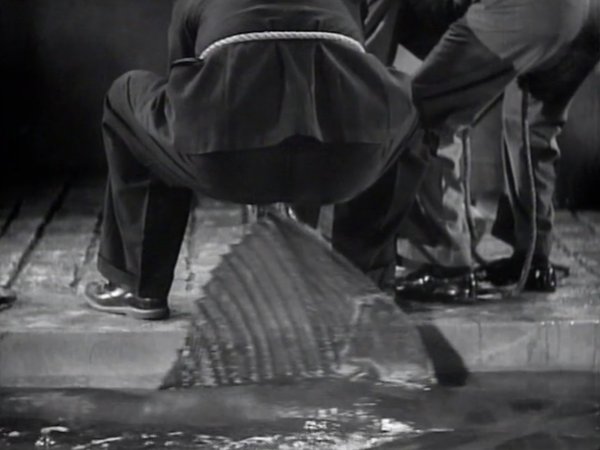 |
Sounds pretty bad when written out, and it doesn't play much better. There is some byplay that augments these scenes, like Stan repeatedly bumping his head on a slanted ceiling and pouring water on Oliver's forehead, as well as a very phony looking shark fin gliding across a bent-over Ollie's derriere (he blames Stan). But overall, this is the initial premise of the film. Of course the duo does not commit suicide. Just as they are about to do so, a legionnaire (Reginald Gardner, who also turns out to be Georgette's husband) on leave spots them and talks them into joining the foreign legion to forget. From there the film becomes a rehash of their superior Roach featurette BEAU HUNKS (James Horne, 1931). In the original film, the boys join the legion so Hardy can forget being jilted by a woman who uses and disposes of men. Victimized, Hardy reacts in sorrowful frustration and simply wants to get away from the problem. In THE FLYING DEUCES, a mere crush on a woman he's knows so little about he never considered the possibility she was married, causes him to sink into a depression deep enough for him to believe killing himself is the answer. |
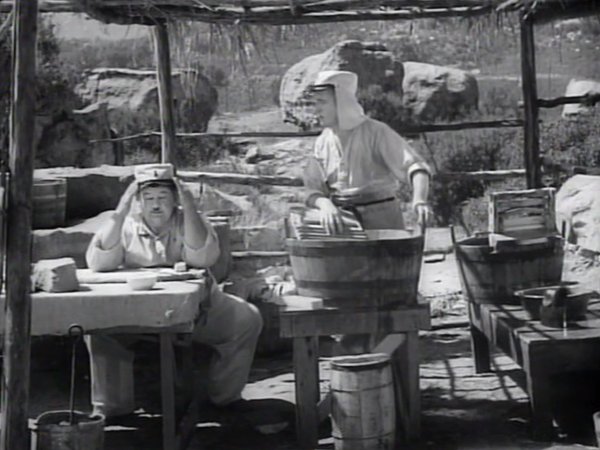
| Charles Middleton repeats his role from the earlier movie as the commander, but rather than do a delightful mixed-up-hats pantomime as in the earlier movie, the boys holler and slap his table about the limited pay they'd be getting resulting in their being punished with laundry and KP duties that are insurmountable (in one of the film's best shots, Sutherland rears the camera back and pans over a seemingly endless line of already washed clothes that stretch beyond the frame). The clothes washing scenes are quite amusing, with Ollie trying to forget (Stan: "think of nothing") and the typical slapstick byplay regarding their duties and the occasional presence of a superior telling them to "get back to work." After the drudgery of washing what seems like thousands of uniforms is about to abate, a truckload of vegetables for them to "manicure" pulls up. That is quite enough for Mr. Hardy ("who's Georgette?" he asks Stan). They decide to simply go home. At this point the film becomes very disjointed. They insult the commander by leaving a nasty note on his desk as they prepare to leave the Legion ("if I could have spelled 'raspberry' I would have said a lot more!"). The commander finds the note, grabs some legionnaires, and goes looking for the boys, now in their street clothes, wandering around apparently trying to find their way out. Sutherland does a nice job blocking the action as the legionnaires and the duo keep narrowly missing each other. They boys end up walking behind the very men who are searching for them, this medium shot held for several seconds as the group just simply walks and walks. The entire business, while superficially amusing, goes on too long. It concludes as the boys stop by a band and do an impromptu song and dance number. |
 |
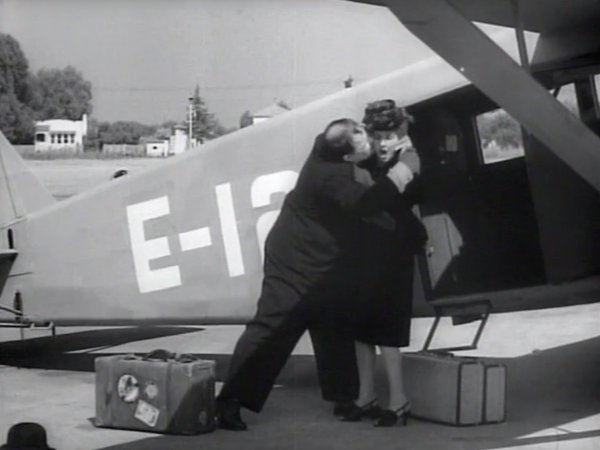 |
It is always fun to hear Ollie sing (as Stan dances), but in other films (e.g. WAY OUT WEST (Horne, 1937)), it is during a period in the film where the tempo has relaxed and the song naturally finds its way as an organic part of the narrative. In THE FLYING DEUCES, it is dropped into a scene where the duo is being pursued, halting the action and seeming jarring and misplaced. As it concludes the boys go wandering off again just a plane lands and Georgette disembarks. Ollie, who had been reserved and shy in his earlier approach to her, having loved her only from afar, suddenly has the chutzpah to start hugging and kissing her as if unable to control his passions. It is one of the more unsettling moments in the film. The much larger Oliver forces himself upon the petite woman who reacts in uncomfortable shock. Her nearby husband interrupts the action and the boys are put in jail. While locked up, the boys are alerted to a tunnel under the floorboard of their cell (it is never revealed just who offers this information) so they tunnel out and escape. An announcement is made that their capture will net a reward, so the boys escape in an airplane despite not knowing how to fly. The plane crashes and Hardy is killed. |
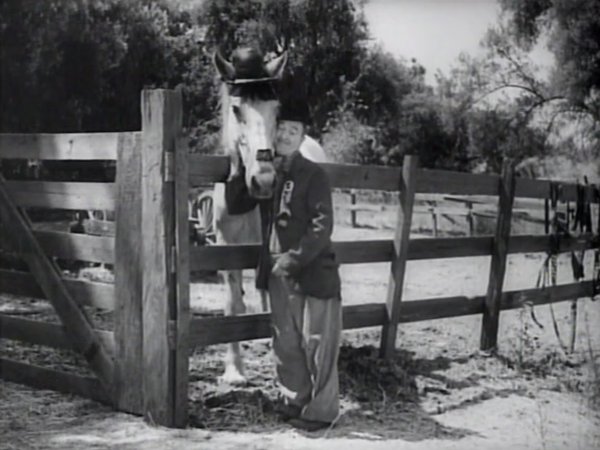
| There is an instance during the earlier suicide scene where Laurel wonders about reincarnation. Hardy indicates he would like to come back as a horse. It is brought up again midway through the movie to remind us. So, at the end, we see a lonely Stanley walking down a path when he hears the voice of his deceased partner call to him. The picture cuts to a white horse with a mustache and derby stating "here's another nice mess you've gotten me into" resulting in a funny and satisfying ending. When approaching THE FLYING DECUES overall, its overall cheapness is immediately evident. Even in the lower budget Roach shorts confined to a certain era, there was usually a fullness of production where the budget was not evident. In this film, the airplane escape scene is limited to only a few shots, including the spinning of a still frame, while the soundtrack repeats a dub of Laurel's cry and Hardy's "doooohhh" reaction. From a cinematic perspective, it may be one of the most poorly produced "highlights" in Laurel and Hardy's entire filmography. |
 |
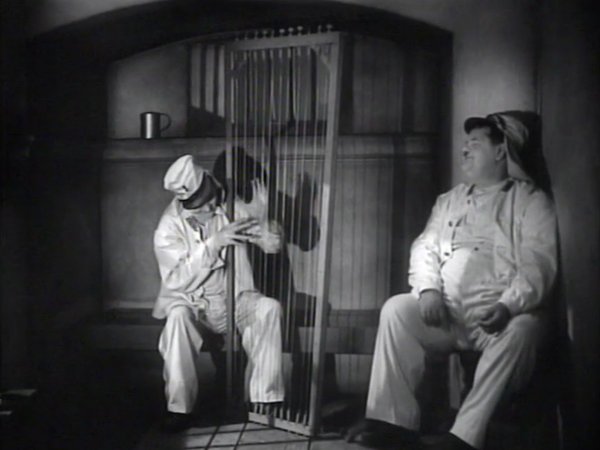 |
There is very little cohesion to the body of the film. Even episodic features like PACK UP YOUR TROUBLES (George Marshall, 1932) had a connection that sustained their narrative while maintaining their sense of fun. THE FLYING DEUCES goes from one scene to the next without a sense of consistent rhythm. After the fun bit with the laundry, we watch them wander around for several minutes (occasionally Laurel breaks up the action by bumping into something). They stop and sing a song. Hardy paws at a woman. They sit in prison. They are alerted to a tunnel where they can escape by an anonymous source that is never revealed. They tunnel out. They end up in Georgette's bedroom. They fly the plane with tragic results. There is a lot about THE FLYING DEUCES that is poorly structured cinema, much more than any other Laurel and Hardy feature. But it is not completely without merit. During the prison sequence, Laurel curiously strums his bed springs, and eventually props up the bed frame and starts playing it like a harp while Hardy, accepting the surrealism, taps his feet to the music. There are several fun gags during the clothes washing sequence. But while the quirky reincarnation gag is creative and funny, the overall depressing element of death that permeates the basic structure of the narrative remains unsettling. |
| Stan Laurel and Oliver Hardy are the greatest comedy team in the history of motion pictures. The enjoyment their films provide is unmatched by nearly any other comedians, even from the fruitful period during which they made these movies. And while no Laurel and Hardy film is without merit, THE FLYING DEUCES is one that offers surprising little of the duo's comic magic, and it's haphazard structure and overall cheapness make it even less appealing. Because its copyright has lapsed, it has become the most easily available Laurel and Hardy movie (there are some whose only exposure to the duo is this rather unimpressive effort). And, as with any Laurel and Hardy movie, the talent, and the appeal, of the comedians always shines through. |
 |
|
AIR RAID WARDENS -- A Pivotal Movie in the Laurel and Hardy filmography. However, any slapstick of the 1940s was very quick, and brash, and outrageous, not so much the "quiet craziness" for which Laurel and Hardy had become famous. Jules White's unit at Columbia, featuring the popular Three Stooges, was leading the pack. Silent movie masters like Buster Keaton and Harry Langdon found work at Columbia, but were expected to maintain some connection to this brash new style. Some claim it to be a failure, but the talents of comedians at the level of Keaton or Langdon could not be overpowered by having to augment their methods. Both produced some very funny comedies for the Columbia short subject unit during their tenure. Laurel and Hardy did not have to go to Columbia, because, unlike Keaton or Langdon, they were able to maintain their status as bankable stars. When the studios sought Laurel and Hardy upon their becoming available in 1941, it was for feature film productions with the majors. They notoriously landed at the prestigious 20th Century Fox studios, where they would remain until 1945, with a couple stops off at MGM along the way. Stan Laurel had the same naïveté in 1941 that Buster Keaton had in 1928 --- that a move to the big studio would not make a difference in their way of doing movies. They would continue to have full supervisory control over all aspects of production. In Buster Keaton's case, he made a couple of good silent features upon his move to MGM, working with Edward Sedgwick as credited director. Once talkies came out, the technologically curious Keaton was excited about working with sound film, but was not allowed to contribute creatively at all. He was placed in unsuitable projects as an actor only, and the results were unsatisfactory. Essentially the same thing happened to Laurel and Hardy when they joined Fox. Laurel was dismayed at having so little input and remained bitter to the end of his life, even though things changed after two movies. The difference between Keaton and the duo is that Keaton was more into visual technology, going way over budget on The General (1927) in order to film a locomotive going over a collapsing bridge, or creating a massive cyclone sequence for Steamboat Bill Jr. (1927). As much as it would have likely benefited screen comedy's cinematic growth to allow Keaton the full resources of MGM to film such expensive sequences, the studio's business-oriented perspective made it a pretty improbable idea. Keaton would also come up with ideas that were a bit heady (a satire on Grand Hotel for which he planned to gather an expensive all-star cast). With Laurel and Hardy, their brilliance lies in their characters and how those characters function in the imperfect world by which they're surrounded. Thus, when given a script, no matter how wrongheaded, the duo is able to bring out elements of those characters to some extent. Their talent, ability, and their charm, always shines through. Great Guns (Monty Banks, 1941), their first film for Fox, was an attempt to capitalize on the success of the wildly popular military comedy Buck Privates (Arthur Lubin, 1941) starring the hot new team of Bud Abbott and Lou Costello. Bud and Lou were burlesque comics whose popularity on stage and radio plopped them into a film contract with Universal studios in 1940. They were very much of the times, with rapid verbal patter, brash personalities, and boisterous slapstick. A-Haunting We Will Go (Alfred Werker, 1942) was an attempt to capitalize on the success of Bud and Lou's Hold That Ghost (Lubin, 1941). Putting Laurel and Hardy in films with similar contexts to Abbott and Costello would naturally net far different results. Laurel and Hardy maintained their usual characters to some extent, but were given much more dialog. These are transitional films in which the duo is placed in a more modern setting. Comedy had changed. Long stretches of pantomime such as Stan patiently eating a hard boiled egg while Ollie sits fuming in a hospital bed, as seen in County Hospital (James Parrott, 1932) would never have worked in this new era. The chief problem with these two films is that the focal point of the narrative is on other characters and Laurel and Hardy's plot seems tangential -- the same problem we have with the Roach features Bonnie Scotland (James Horne, 1935), and Swiss Miss (John Blystone, 1938). Stan Laurel was unhappy with this having to adapt to a style of comedy unlike the one he'd known so well, but he remained professional. There are moments in both of these disappointing movies, while Great Guns continues to really come alive with an audience. There are moments of brashness that would not have fit in the Roach era, anymore than spending three minutes eating a wax apple would have fit in this era. Many have stated that if Laurel and Hardy went to another studio, it would have been different. Actually, this is how comedy was during the 40s. It stands to reason that any major studio would have expected the same augmentation of their style. Their only choice would be to quit films and get other jobs, which is, of course, ridiculous. Both of these first two Fox films were box office hits. After these first two films at Fox, Laurel and Hardy made a movie for MGM. For Air Raid Wardens, they are given a couple of old cronies from Roach to help on the script, Keaton's old comrade Edward Sedgwick was placed in the director's chair, and allegedly Keaton himself was one of the gag men. This is all very promising, but this did not reset the change in how comedy movies were made in the 1940s. They would still have dialog, but because of being surrounded by those familiar with them and their work, their creative freedom improved. This does not make Air Raid Wardens a great film by any means, but it does make it an important one. Several typical Laurel and Hardy routines are interspersed throughout this feature, and the duo is the focal point of the narrative. They are again surrounded by a hostile world in which they must persevere, and they come out on top at the end. This is the usual narrative trajectory for any successful Laurel and Hardy movie. There are two different tit-for-tat sequences with the great Edgar Kennedy, with whom they'd worked several times at the Roach studios. It is obvious Sedgwick left the three of them alone to perform their back-and-forth slapstick battle. The pace is faster, but still leisurely. There is time for Edgar's slow burn and Oliver's looks to the camera. Stan and Ollie help out a friend by putting up posters. Painting the backs with glue and getting more on themselves, placing them upside down or in the wrong spot, and other such calamities ensue. They enter a town meeting late, followed by a stray dog that Stan fed earlier. They try not to make a commotion, but Stan squeaks with every step. "Take off your shoes," Ollie instructs. Stan does, but the squeaking continues. It is his feet, not his shoes. Stan blames it on rheumatism. The dog becomes a barking disruption and they do their comic best to quiet him. All of this comedy is performed in the Laurel and Hardy manner and it shows that the comedians could comfortably fit into the new era of comedy. There are a few drawbacks, however. This is an MGM wartime film, so it is very patriotic. A civil service representative was on the set and was critical any time the comedy seemed to be poking good-natured fun at the task of the wardens, thus hampering a lot of the fun. The context of the story is set in a classic MGM small town setting (e.g. the Andy Hardy series) but Laurel and Hardy fit well in these folksy surroundings, especially since the haughty ersatz society people are among their nemeses. Perhaps the biggest problem with Air Raid Wardens is MGM's penchant for having a seen where the leading comedians hit absolute rock bottom before finding their way back up by proving themselves. Stan and Ollie sitting around dejectedly, trying to think of ways to cheer up ("Wanna go to the park and feed the birds?" "Want me to read you the funnies?") has some manner of poignancy, but slows down the pace. They should not pause before they keep trying. Actress Ann Rutherford told me: Air Raid Wardens is a pleasant comedy, but its importance goes beyond that. It is a return to elements of the traditional Laurel and Hardy style and set the pattern for their subsequent movies during the 1940s. Laurel and Hardy had to adapt to changing trends in comedy and filmmaking, cinema was going to change for them. So, when given some creative input, they found a way to maintain their characters and their comic methods within this new context. After Air Raid Wardens, they continued to have some input, more of an effort was made to allow for more traditional Laurel and Hardy comedy, and their movies steadily improved from this point. Many consider their return Fox film, Jitterbugs, as their most aesthetically successful 1940s feature. This is interesting, because Jitterbugs is the most atypical Laurel and Hardy film of them all. But the argument is that it shows how the talented comedians could command a completely offbeat comedy with real success. It does, but it is ultimately less satisfying than seeing them doing what they did best. What is important about Jitterbugs is their being given director Malcolm St. Clair, who had a long history with comedy, including collaborating on two of Buster Keaton's finest silent shorts (The Goat and The Blacksmith). The duo got along famously with St. Clair, and the three collaborated to make each successive feature better. The Dancing Masters was an improvement, maintaining a topical story but including several Laurel and Hardy routines. With The Big Noise, however, Laurel and Hardy's input and their collaborations with director St. Clair were even more evident. Stan's curiosity in a home filled with push button devices, a superior update of an old upper berth sequence they had done back in 1929, Ollie climbing a pole to read a street sign, only to find it is a Wet Paint sign, are among the many highlights of this delightful later Laurel and Hardy comedy. Oliver Hardy, especially, is in fine form, offering several looks to the camera and double takes. The Big Noise is their best film since Blockheads some six years earlier. The Bullfighters, continued this trend, and is, like The Big Noise, a conventional Laurel and Hardy comedy. Stan himself directed two slapstick set pieces --one involving a fountain and the other an egg-breaking routine they had done in an earlier movie -- while Malcolm St. Clair sat back approvingly. The Bullfighters equaled the strength of The Big Noise. During this time, Laurel and Hardy also stopped back at MGM to make another feature, but Nothing but Trouble (Sam Taylor, 1944) was, like Air Raid Wardens, given a structure where the comedians reach their lowest point before coming out on top at the end. While it has some fleeting, funny moments, many believe Nothing But Trouble to be the duo's weakest feature. Laurel and Hardy ended their film career in 1945 after The Bullfighters, returning to the stage, touring with a couple of sketches, and making one more movie in France in 1950 (Atoll K, also known as Utopia). Stan maintained a certain bitterness about Fox due to not having the full supervisory control he expected, especially with the duo's first two features. This was printed in a popular biography of the duo, that author claiming each movie got progressively worse during this period and the films should never have been made. It was later discover that this author had not seen any of the movies. A few years later, a book examining the duo's films named The Big Noise as the worst, and A Haunting We Will Go and Jitterbugs as their best from this period. The assessment of A-Haunting did not stick, but the reaction to the other films has, conditioning many fans that read the book years ago and carried this opinion thereafter. Now that all of the films are on DVD, new fans discovering the comedies, who have not been instructed which films to like or dislike, have been making up their own minds. A book examining only the 40s films embraces a revisionist approach to the previous claims, carefully pointing out the merit of each, and naming Air Raid Wardens among the most typical and conventional of Laurel and Hardy's later movies, along with The Big Noise and The Bullfighters. As the author of From The Forties Forward, Scott McGillivray stated, "Are the forties films better than the Roach films? Sometimes", explaining that the milking of gags in the earlier movies sometimes goes on too long (Stan Laurel agreed and wanted to re-edit the movies himself after they started playing on TV in the early 1950s). Laurel and Hardy are the greatest comedy team in the history of motion pictures. It is not very objective or open minded to dismiss an entire portion of their career because of their adapting to the changing trends in comedy, especially by past authors who had not seen the films they're judging. Laurel and Hardy continued to enjoy box office success with their 1940s films, and as they were allowed greater input, their movies improved as well, as they successfully maintained their conventional style within the context of the more modern approach. Of all the silent movie comedians whose work extended as late as the 1940s, Laurel and Hardy's films come out best. |
| Acknowledgements: Jim Neibaur: ("The Flying Deuces" article - May 1st, 2014) ("Air Raid Wardens" article - May 4th, 2014) This page was last updated on: 04 May 2014 |